
Exhibition · Musubu Espai Cultural, Barcelona
The Footprint of Fire
Kujiragama: first firing
16 – 29 October 2026
Opening Friday 16 October, 19:00 – 21:00

A selection of pieces from the first firing of Kujiragama, the anagama wood kiln at Can Brull.
For 84 hours, fire, ash, temperature and time transformed each piece in a way that cannot be repeated. This page gathers the material behind the show: the people, the kiln, the firing, and how it all works.
The story of a kiln, a community, and a first fire
From Bizen to Montseny
The story of Kujiragama began long before the first brick was laid. It began in Bizen, Japan, during long days working with clay, nights feeding the fire, and conversations around the kiln.
It was there that Magali Kivatinetz met Taiga Mori, a Bizen ceramic artist who welcomed her as his apprentice. Through shared firings, long hours working together and time spent with Taiga’s family, a friendship developed alongside a deeper understanding of the Japanese tradition of wood firing.
During one of those visits, almost spontaneously, Magali asked Taiga a question: What if we built an anagama at Can Brull, in the mountains of Montseny, near Barcelona?
Taiga said yes.
What began as a simple conversation suddenly became the possibility of something much bigger.
Later, in Denmark, they met Frank Richter, a German ceramic artist with extensive experience in wood-fired kilns. When they shared the idea with him, Frank also wanted to be part of the adventure.
Three people from different backgrounds, connected by a shared passion for ceramics, found themselves at the beginning of a project none of them could fully imagine yet.
The intention was never simply to reproduce a Japanese kiln in Catalonia, but to share the knowledge and spirit of a centuries-old tradition and allow it to find its own life in a new place.
What began with a spontaneous question in Bizen was about to become a collective journey.
Kujiragama was still only a dream, but the people who would bring it to life had already found each other.


Taiga Mori
Bizen ceramicist and sensei, and the designer of Kujiragama. His knowledge guided the kiln's form, spirit, and relationship with the Japanese wood-firing tradition.

Magali Kivatinetz
Founder of MK Pottery Studio and steward of Can Brull, her home. Magali drove Kujiragama from the first idea, and made an anagama of this scale real in Catalonia.

Frank Richter
German ceramicist and a newer member of the family. Frank was the technical vision of the build, with deep wood-kiln knowledge and tireless work.
The birth of Kujiragama · Spring 2026
In the spring of 2026, a group of ceramic artists and collaborators from different parts of the world arrived at Can Brull to take part in an ambitious project: building an anagama kiln inspired by the Japanese tradition of Bizen.
Guided by Taiga’s design and experience, with Frank’s technical knowledge and Magali coordinating the project, more than fifteen people worked together for weeks, laying nearly three thousand bricks, learning new techniques and discovering the complexity of building a wood-fired kiln.
The days were long and physically demanding. There were bricks to cut, mortar to mix, decisions to make and unexpected problems to solve. But there were also shared meals, conversations, laughter, new friendships and the experience of creating something together.
Knowledge was shared through observation, conversation and practice, with everyone contributing, questioning and learning from one another.
Building Kujiragama was not always straightforward. Some things had to be reconsidered, others taken apart and rebuilt. Along the way, the team learned that building something meant to last requires patience, humility and the willingness to recognize mistakes and begin again.
Slowly, Kujiragama took shape.
Its name comes from the Japanese words kujira, meaning whale, and gama, meaning kiln, inspired by its long, rising form.
But Kujiragama became much more than a structure of refractory bricks. It became the result of the knowledge, dedication, generosity and friendship of everyone who helped bring it to life.
The kiln had a history long before it had its first fire.

October 2026 · Learning to listen to the kiln
On October 1, 2026, Kujiragama was lit for the very first time.
After months of preparation, the kiln was finally ready to begin its true purpose: transforming clay through fire, wood, ash and time.
What followed was an intense and unforgettable experience.
For 84 hours, through days and nights, an international team of ceramic artists and participants worked together, feeding the fire, watching the temperatures rise and learning to understand the behaviour of a kiln that had never been fired before.
Heavy rain, strong winds, mud, exhaustion and temperatures reaching 1300°C tested both the kiln and the people working around it.
There were moments of excitement and joy, but also frustration, difficult decisions, mistakes and unexpected problems.
Kujiragama revealed a character of her own. She demanded attention, patience and respect. The team had to learn to listen to her, to understand how the fire moved through her chamber and how she responded to every decision.
The first firing was not simply about reaching a temperature. It was about learning to work with the fire, accepting uncertainty and understanding that every firing is a collaboration between the people, the materials and the kiln itself.
The pieces presented in this exhibition are the result of that first encounter.
Each carries the marks of flame, ash, atmosphere and time. Some reveal beautiful surprises; others bear witness to the difficulties and unpredictability of wood firing.
Together, they tell the story of a first fire, with all its uncertainties, discoveries and imperfections.
Kujiragama had finally come to life. And she had already become a teacher.
Five days around the fire
30 Sep · Loading
Shelves, wadding, fire clay, ash and rice straw. Placement decides what the fire will do to each piece.
1 Oct · Lighting
The kiln is closed and lit. An anagama heats slowly; the first hours are about reading it.
2 Oct · Climbing
Rhythm of wood and air. Flame movement and atmosphere inside the chamber.
3 Oct · Side stoking
Maturation temperature, damper and air channels. Reduction, ash deposits, flashing.
4 Oct · Sealing
The firing ends and the kiln is sealed. Days of cooling before the opening at Aki Matsuri.

A story still being written
Kujiragama was never intended to be just a kiln.
From the beginning, the project was imagined as a place for people to come together, exchange knowledge, explore materials and share the experience of working with fire.
Rooted in the centuries-old ceramic traditions of Bizen, Japan, and now finding its own identity in the landscape of Montseny, Kujiragama represents a meeting between cultures, generations and ways of understanding ceramics.
But this is only the beginning.
Every firing will bring new questions, new discoveries and new possibilities. Each artist who participates will contribute something different, and every piece that enters the kiln will become part of a process much larger than the space it occupies inside.
The hope is that Kujiragama will continue to grow into a place of experimentation, learning, collaboration and community, welcoming ceramic artists, students and anyone curious about the transformative power of fire.
Because the true value of Kujiragama lies not only in the objects it produces, but also in the people, experiences and relationships that develop around it.
This exhibition marks the beginning of a much longer story. A journey that has only just begun, and one that is meant to be shared.

Inside Kujiragama


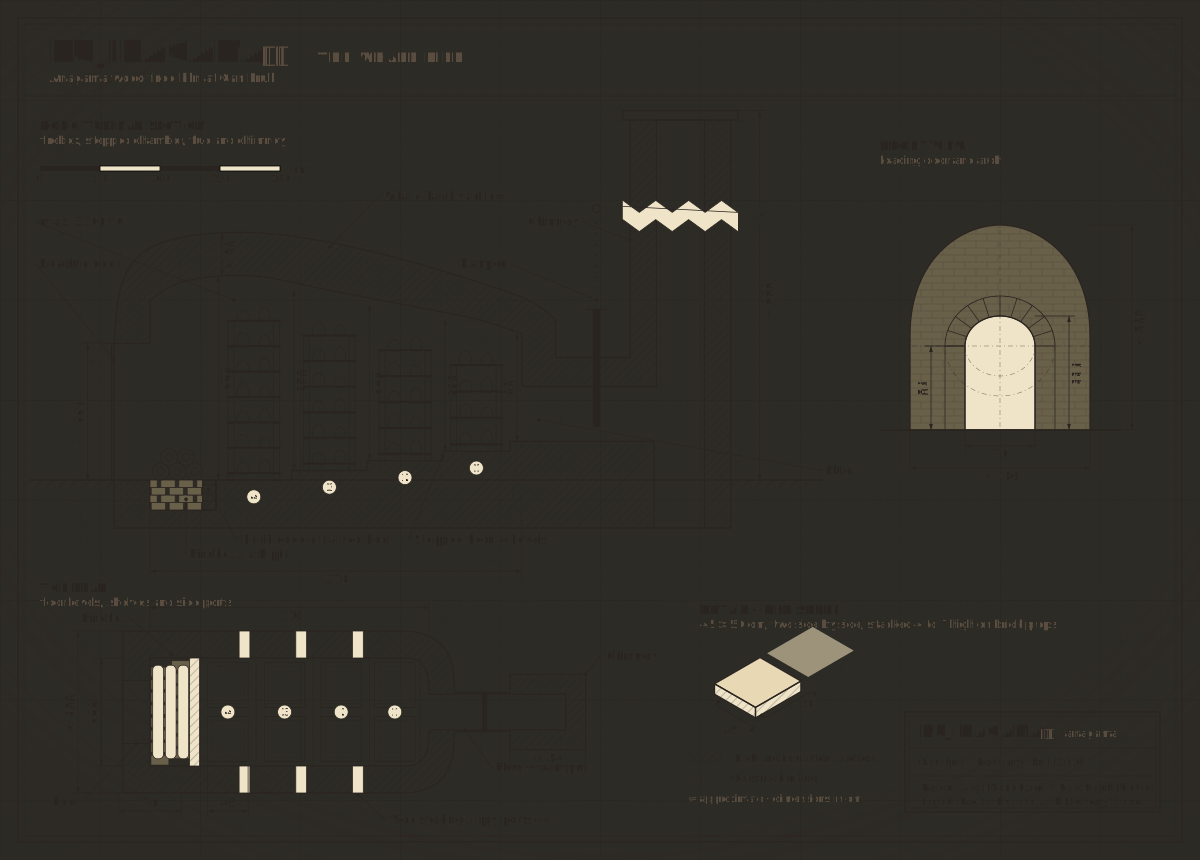
- Tunnel length
- 310 cm
- Door
- 70 × 114 cm
- Ceiling height, stepped chamber
- 170 → 90 cm
- Shelf size
- 45 × 50 cm
Learn about anagamas and Kujiragama
Seven short chapters explain how an anagama works and what makes Kujiragama the kiln it is: the pull of the chimney, what wood does in the fire, air, atmosphere, side stoking, and the design choices behind it. Narrated in your language, with subtitles.
- 1:02
01 The anagama: a tube of fire on a hillside
- 1:05
02 Anatomy of an anagama
- 3:57
03 The physics: draft, fire, the climb, the stall
- 2:50
04 Stoking: the side ports and the rhythm
- 3:07
05 Atmosphere: oxidation, reduction and the air that sets them
- 2:18
06 Design choices and other wood kilns
- 0:46
07 Reaching 1300 degrees
Visit the exhibition
Free entry by appointment. Contact Musubu by WhatsApp (+34 722 60 40 46) or info@musubu-bcn.org before visiting.
Musubu Espai Cultural · Carrer Rodríguez 3, 08028 Barcelona